Most Read
Abstract
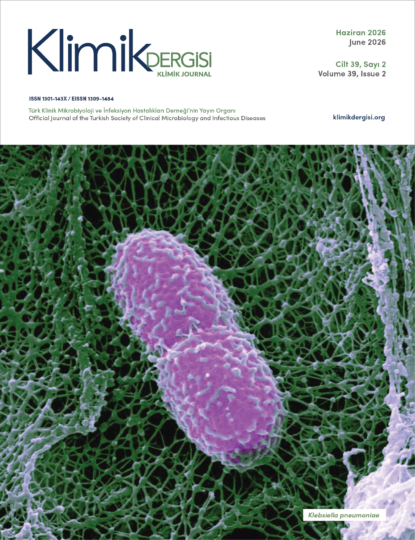
Objective: This study aimed to evaluate the biofilm formation and susceptibility of Klebsiella pneumoniae and Acinetobacter baumannii strains, isolated as causative agents of ventilator-associated pneumonia (VAP), to meropenem and amikacin using various antimicrobial susceptibility testing methods. Additionally, the study investigated the potential impact of biofilm formation on the outcomes of agar-based antibiotic susceptibility tests.
Methods: K. pneumoniae and A. baumannii strains were isolated from tracheal aspirate samples of patients diagnosed with VAP between October 2019 and June 2021 in the intensive care unit. Biofilm production was tested using the tissue culture plate method. Broth microdilution, E-test, and disk diffusion methods were used to assess susceptibility to meropenem and amikacin. The agreement between these methods was evaluated using the Kappa test.
Results: Among 98 isolates, 67 were identified as A. baumannii and 31 as K. pneumoniae. Biofilm production was detected in all K. pneumoniae isolates and 83.6% of A. baumannii isolates. Biofilm formation was significantly more frequent in K. pneumoniae (p=0.015). Resistance rates determined by the microdilution method were significantly higher in A. baumannii isolates for both meropenem (p=0.003) and amikacin (p=0.042) compared to those of K. pneumoniae. In biofilm-producing K. pneumoniae, agreement among test methods was stronger for meropenem (kappa=0.71) than for amikacin (kappa=0.32).
Conclusion: Although the number of tested isolates in our study was limited, concordance was observed between disk diffusion, E-test, and microdilution methods for meropenem in biofilm-producing K. pneumoniae strains. However, the same level of agreement was not observed for amikacin. It is considered that the formation of biofilm-like structures on the agar surface by microorganisms, combined with the hydrophilic nature of amikacin limiting its penetration into these structures, may significantly affect the test results.

A Correction to this article was published on 24 October 2025. https://doi.org/10.36519/kd.2025.5422
References
- Lindsay D, von Holy A. Bacterial biofilms within the clinical setting: what healthcare professionals should know. J Hosp Infect. 2006;64(4):313-25. [CrossRef]
- Høiby N, Ciofu O, Johansen HK, et al. The clinical impact of bacterial biofilms. Int J Oral Sci. 2011;3(2):55-65. [CrossRef]
- Donlan RM, Costerton JW. Biofilms: survival mechanisms of clinically relevant microorganisms. Clin Microbiol Rev. 2002;15(2):167-93. [CrossRef]
- Gunardi WD, Karuniawati A, Umbas R, et al. Biofilm-producing bacteria and risk factors (gender and duration of catheterization) characterized as catheter-associated biofilm formation. Int J Microbiol. 2021;2021:8869275. [CrossRef]
- Wilson A, Gray D, Karakiozis J, Thomas J. Advanced endotracheal tube biofilm stage, not duration of intubation, is related to pneumonia. J Trauma Acute Care Surg. 2012;72(4):916-23. [CrossRef]
- Del Pozo JL. Biofilm-related disease. Expert Rev Anti Infect Ther. 2018;16(1):51-65. [CrossRef]
- Danin PE, Girou E, Legrand P, et al. Description and microbiology of endotracheal tube biofilm in mechanically ventilated subjects. Respir Care. 2015;60(1):21-9. [CrossRef]
- Inglis TJ, Millar MR, Jones JG, Robinson DA. Tracheal tube biofilm as a source of bacterial colonization of the lung. J Clin Microbiol. 1989;27(9):2014-8. [CrossRef]
- Gordon CA, Hodges NA, Marriott C. Antibiotic interaction and diffusion through alginate and exopolysaccharide of cystic fibrosis-derived Pseudomonas aeruginosa. J Antimicrob Chemother. 1988;22(5):667-74. [CrossRef]
- Diaconu O, Siriopol I, Poloșanu LI, Grigoraș I. Endotracheal tube biofilm and its impact on the pathogenesis of ventilator-associated pneumonia. J Crit Care Med (Targu Mures). 2018;4(2):50-5. [CrossRef]
- Marcinkiewicz J, Strus M, Pasich E. Antibiotic resistance: a “dark side” of biofilm associated chronic infections. Pol Arch Med Wewn. 2013;123(6):309-13.
- The European Committee on Antimicrobial Susceptibility Testing (EUCAST). Disk diffusion method for antimicrobial susceptibility testing. Version from March 2014 [Internet]. Växjö: EUCAST; 2014 [erişim 20 Ekim 2024]. https://www.eucast.org/fileadmin/src/media/PDFs/EUCAST_files/General_documents/Publications/Disk_diffusion_paper_printed_version_March_2014.pdf
- Metersky ML, Kalil AC. New guidelines for nosocomial pneumonia. Curr Opin Pulm Med. 2017;23(3):211-7. [CrossRef]
- Stiller A, Schröder C, Gropmann A, et al. ICU ward design and nosocomial infection rates: a cross-sectional study in Germany. J Hosp Infect. 2017;95(1):71-5. [CrossRef]
- Healthcare-associated infections (HAIs) [Internet]. Atlanta: The Centers for Disease Control and Prevention (CDC). [erişim 25 Nisan 2021]. https://www.cdc.gov/hai/
- Vincent JL. Nosocomial infections in adult intensive-care units. Lancet. 2003;361(9374):2068-77. [CrossRef]
- Christensen GD, Simpson WA, Younger JJ, et al. Adherence of coagulase-negative staphylococci to plastic tissue culture plates: a quantitative model for the adherence of staphylococci to medical devices. J Clin Microbiol. 1985;22(6):996-1006. [CrossRef]
- Vuotto C, Longo F, Pascolini C, et al. Biofilm formation and antibiotic resistance in Klebsiella pneumoniae urinary strains. J Appl Microbiol. 2017;123(4):1003-18. [CrossRef]
- Harika K, Shenoy VP, Narasimhaswamy N, Chawla K. Detection of biofilm production and its impact on antibiotic resistance profile of bacterial isolates from chronic wound infections. J Glob Infect Dis. 2020;12(3):129-34. [CrossRef]
- Alamri AM, Alsultan AA, Ansari MA, Alnimr AM. Biofilm-formation in clonally unrelated multidrug-resistant Acinetobacter baumannii isolates. Pathogens. 2020;9(8):630. [CrossRef]
- Kalil AC, Metersky ML, Klompas M, et al. Management of Adults with Hospital-Acquired and Ventilator-Associated Pneumonia: 2016 Clinical Practice Guidelines by the Infectious Diseases Society of America and the American Thoracic Society. Clin Infect Dis. 2016;63(5):e61-e111. Erratum in: Clin Infect Dis. 2017;64(9):1298. Erratum in: Clin Infect Dis. 2017;65(8):1435. Erratum in: Clin Infect Dis. 2017;65(12):2161. [CrossRef]
- Stepanović S, Vuković D, Hola V, et al. Quantification of biofilm in microtiter plates: overview of testing conditions and practical recommendations for assessment of biofilm production by staphylococci. APMIS. 2007;115(8):891-9. [CrossRef]
- The European Committee on Antimicrobial Susceptibility Testing (EUCAST). EUCAST reading guide for broth microdilution: version 5.0, 2024 [Internet]. Växjö: EUCAST; 2024 [erişim 20 Ekim 2024]. https://www.eucast.org/fileadmin/src/media/PDFs/EUCAST_files/MIC_testing/Reading_guide_BMD_v_5.0_2024.pdf
- Wang M, Wei H, Zhao Y, et al. Analysis of multidrug-resistant bacteria in 3223 patients with hospital-acquired infections (HAI) from a tertiary general hospital in China. Bosn J Basic Med Sci. 2019;19(1):86-93. [CrossRef]
- Gürbüz E, Çelik M, Yıldız A. [Evaluation of infectious agents, species, and resistance profiles of healthcare-associated infections]. Klimik Derg. 2023;36(2):144-50. Turkish. [CrossRef]
- Gürpınar Ö, Ergin A, Zarakolu P, Köseoğlu Eser Ö. [Biofilm production and presence of virulence genes in invasive and non-invasive Acinetobacter baumannii isolates]. Flora. 2021;26(4):720-6. Turkish. [CrossRef]
- Schembri MA, Blom J, Krogfelt KA, Klemm P. Capsule and fimbria interaction in Klebsiella pneumoniae. Infect Immun. 2005;73(8):4626-33. [CrossRef]
- Moolchandani K, Sastry AS, Deepashree R, Sistla S, Harish BN, Mandal J. Antimicrobial resistance surveillance among intensive care units of a tertiary care hospital in Southern India. J Clin Diagn Res. 2017;11(2):DC01-7. [CrossRef]
- Barnsteiner S, Baty F, Albrich WC, et al; Swiss Centre for Antibiotic Resistance (ANRESIS). Antimicrobial resistance and antibiotic consumption in intensive care units, Switzerland, 2009 to 2018. Euro Surveill. 2021;26(46):2001537. [CrossRef]
- Raman G, Avendano EE, Chan J, Merchant S, Puzniak L. Risk factors for hospitalized patients with resistant or multidrug-resistant Pseudomonas aeruginosa infections: a systematic review and meta-analysis. Antimicrob Resist Infect Control. 2018;7:79. [CrossRef]
- Liu P, Li X, Luo M, et al. Risk factors for carbapenem-resistant Klebsiella pneumoniae infection: A meta-analysis. Microb Drug Resist. 2018;24(2):190-8. [CrossRef]
- Percival SL, Suleman L, Vuotto C, Donelli G. Healthcare-associated infections, medical devices and biofilms: risk, tolerance and control. J Med Microbiol. 2015;64(Pt 4):323-34. [CrossRef]
- Ataman M, Çelik BÖ. Investigation of the in vitro antimicrobial activity of eravacycline alone and in combination with various antibiotics against MDR Acinetobacter baumanni strains. BMC Microbiol. 2025;25(1):167. [CrossRef]
- Oyardi O, Hacioglu M, Yilmaz FN, Inan N, Birteksoz Tan AS. Antibiotic susceptibility and biofilm formation of multi-drug resistant Gram-negative bacteria. Istanbul J Pharm 53(1):45-50.
- Hatch RA, Schiller NL. Alginate lyase promotes diffusion of aminoglycosides through the extracellular polysaccharide of mucoid Pseudomonas aeruginosa. Antimicrob Agents Chemother. 1998;42(4):974-7. [CrossRef]
- Aytaç Ö, Öner P, Şenol FF, Aşçı-Toraman Z. [Comparison of colistin resistance results of multiple resistant clinical Acinetobacter baumannii isolates with broth microdilution, sensititre, and two different automated systems]. Klimik Derg. 2022;35(3):159-63. Turkish. [CrossRef]
-
This work is licensed under a Creative Commons Attribution-NonCommercial 4.0 International License (CC BY-NC 4.0).